Streaming eSense data to a PC/Mac/Browser (eSense Web App, OSC, LSL)
We offer advanced users such as biofeedback trainers, therapists and coaches the ability to stream the measurement data of the eSense sensors via the eSense app to a PC as well. Thus, group courses can be realized or remote training, whereby the trainee can be in a very different place than the trainer. Even a remote supervision is easy.
Unlock via In-App Purchase
The OSC and LSL data transfer are paid add-on features of the eSense App and are unlocked via an in-app purchase directly inside the app. You will find the purchase under the “In-App Purchases” tab in the eSense App settings. Once unlocked, the OSC and LSL settings appear automatically in the app.
Already included with the professional eSense Set: Customers of a professional eSense set (https://mindfield-shop.com/produkt/esense-set-exkl-sdk) receive the unlock as part of the set — for these users no additional in-app purchase is required.
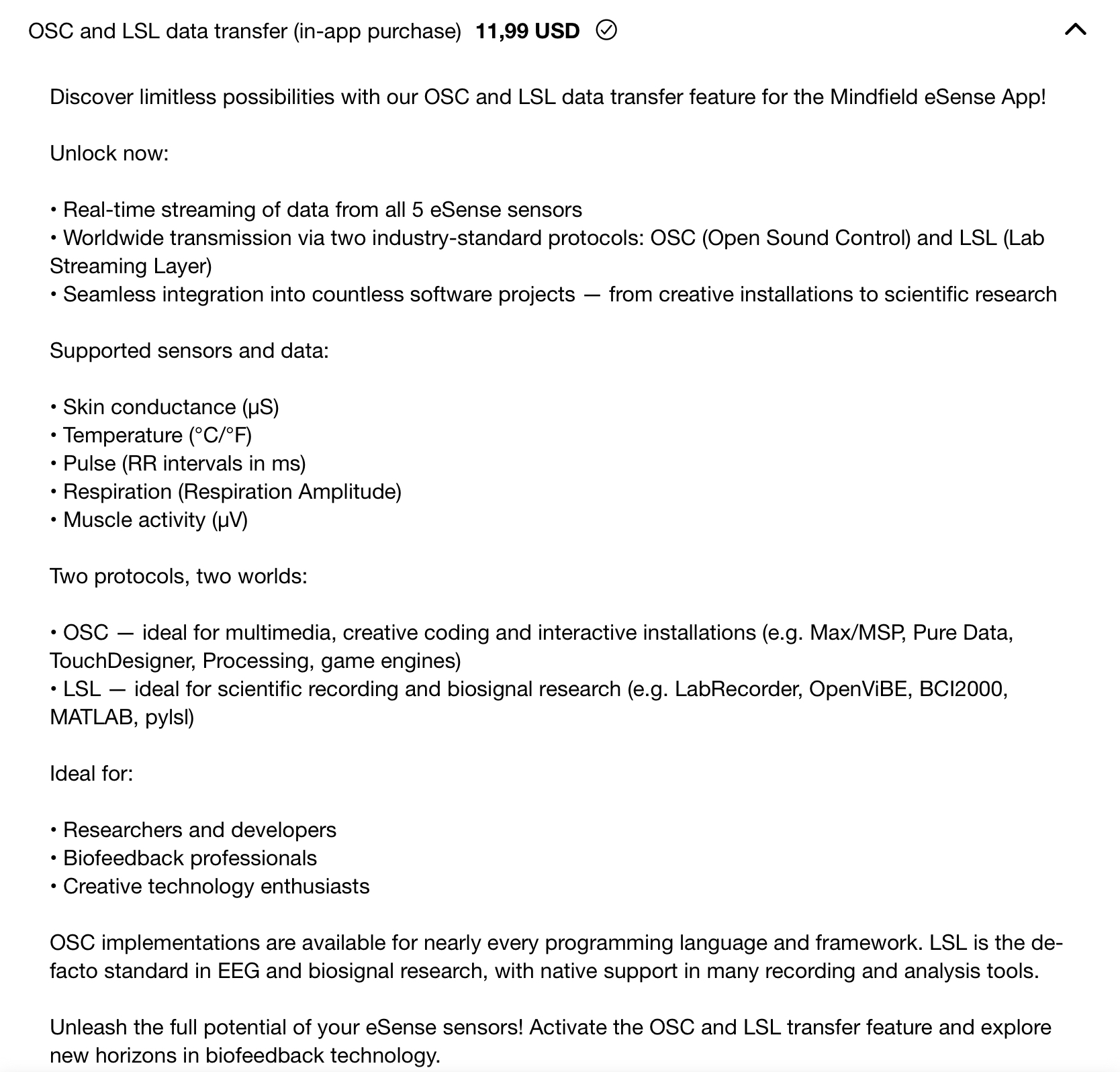
Note on the price: The price displayed (in the screenshot 11.99 USD as an example) is variable and may differ depending on your region, currency and the current Apple/Google App Store pricing tier. The applicable price for you is shown inside your eSense App in your local currency. The purchase is processed via your Apple or Google account; once unlocked, the feature is permanently tied to your account.
Starting with version 8.x of the eSense App, we offer you three ways to transfer data from the eSense App to a PC, Mac or browser: our eSense Web App, the OSC transfer (Open Sound Control), and the LSL transfer (Lab Streaming Layer). All three can even be used in parallel; usually, however, it makes sense to pick the one that best fits your target application.
- eSense Web App – the simplest option, ideal for coaching, group courses and live observation in the browser
- OSC – low-latency streaming for multimedia, creative coding and real-time sound control (e.g. Max/MSP, Pure Data, TouchDesigner, Processing, game engines)
- LSL – the de-facto standard in scientific biosignal recording (e.g. LabRecorder, OpenViBE, BCI2000, MATLAB, pylsl)
eSense Web App
With the eSense Web App for iOS and Android, we have also developed an eSense web app for the browser, which mirrors and supplements the eSense mobile app.
You need an account for the eSense app and one of our plans. You can analyze your recorded data in the browser (with the basic plan) or even stream it in real time to a PC (with the premium plan). With the eSense Web App you can view the measurements of several and different eSenses simultaneously and in real time.
For example as professional user you can watch and look after a group of 5 different users, each with their own eSense. Different sensors, for example an eSense Skin Response with an eSense Pulse or Temperature or Respiration, can be freely combined. The users can even be distributed around the world. They just need a smartphone, an eSense sensor, the mobile app and a booked plan. More information about the plans soon here.

As a private user, you can also benefit from the fact that you can see the graph even better with a large screen and enlarge individual areas.
You will find the eSense Web App at https://esense.live. There you can log in with the same account (username and password) as for the eSense mobile app.
OSC and LSL – Real-Time Streaming Protocols for Biosignal Data
From version 8.x onwards, the eSense App settings contain a combined “OSC and LSL” section. Both protocols allow you to forward the live measurement data of your eSense sensors to external applications in real time – they can be activated independently or used in combination.
OSC Transfer
OSC (https://opensoundcontrol.stanford.edu) stands for “Open Sound Control” and is an open-source network protocol developed by the University of California at Berkeley. It is widely used in the music industry because it is great for processing different signals in real time (for example, at a concert where multiple microphones and lights have to be matched in real time).
This makes the protocol particularly well suited for the real-time data transmission of several eSenses. Due to its wide adoption in the music industry, there are already several extensions and plugins which you can adapt relatively easily and use in your own software. These are usually available in all common programming languages like Android, iOS, Java, JavaScript, C++, Python and many more. Typical target applications are Max/MSP, Pure Data, TouchDesigner, Processing and game engines.
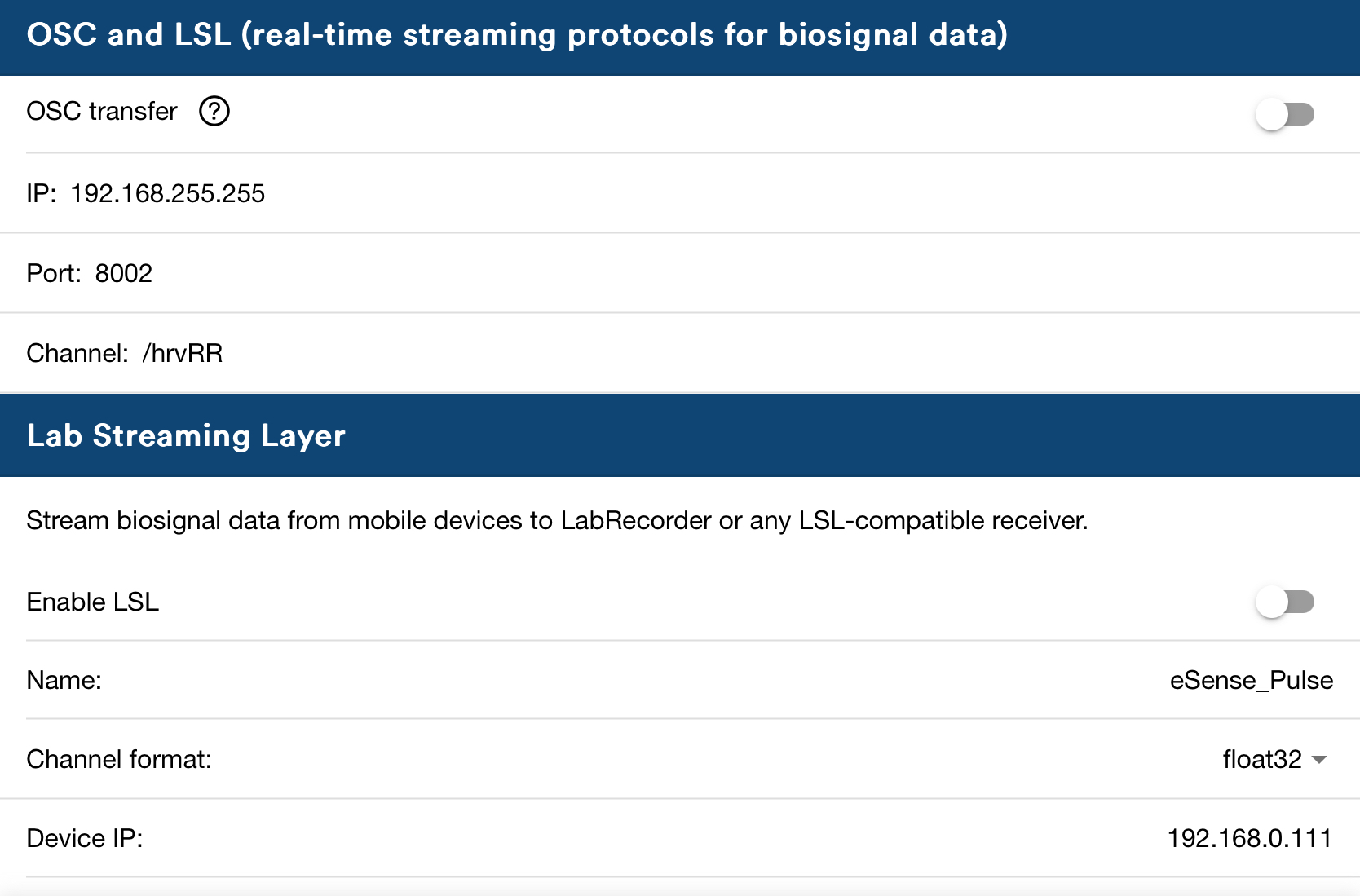
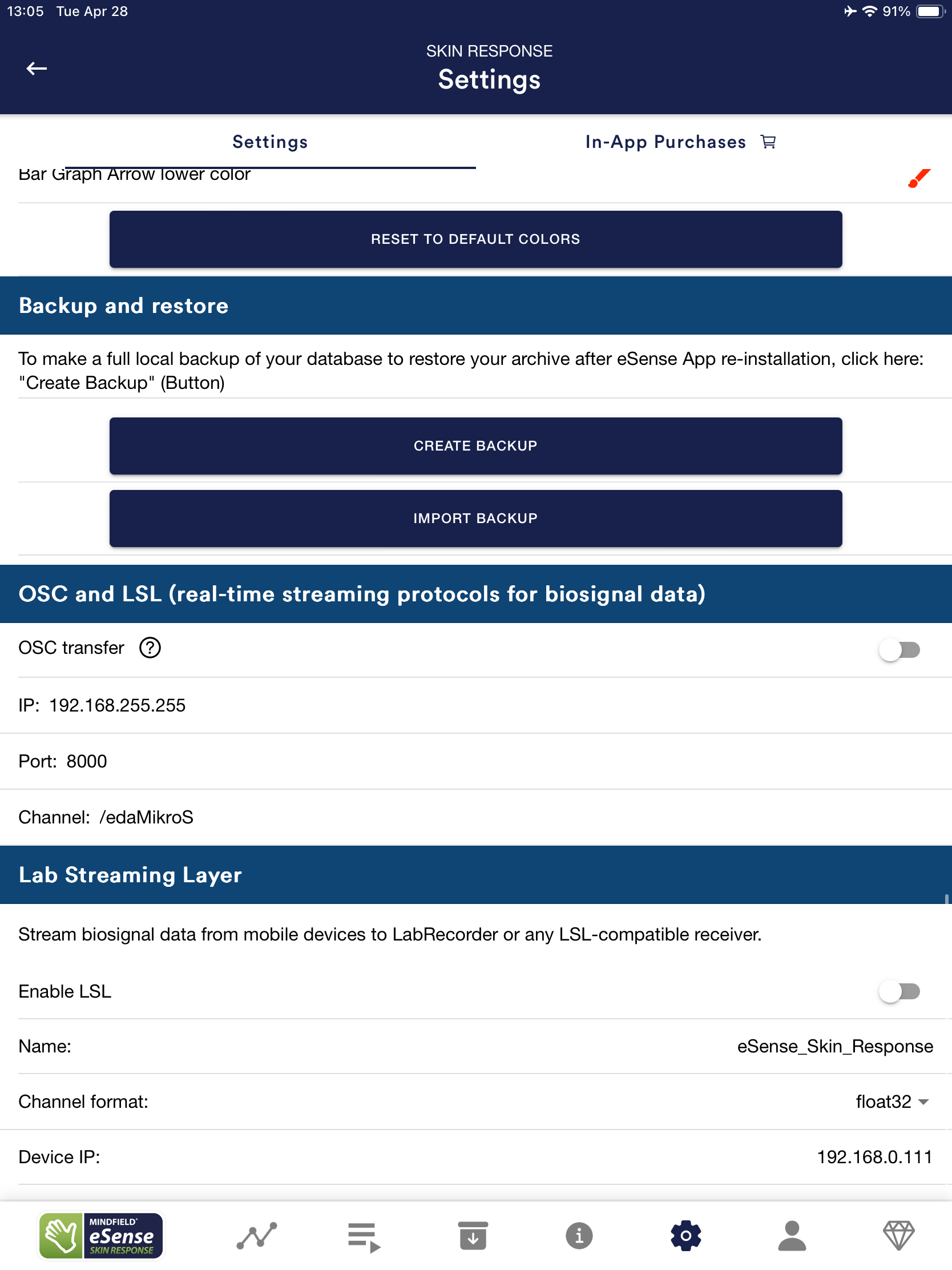
To use OSC with the eSense app, you must define the IP address of the receiver. This can be a local IP address or an IP address on the internet. You can define the ports as you wish. You should pay attention to firewalls, as they may block the flow of data.
In the app you can also define a variable to be able to assign different eSense devices. This allows you to sort, filter and analyze the eSense (or its users) more easily.
The OSC transfer is aimed at programmers of (Windows or Mac) software who want to integrate the data from the eSense. The available OSC libraries in the usual programming languages make such an integration very easy.
LSL Transfer (Lab Streaming Layer)
LSL stands for “Lab Streaming Layer” and is an open-source system for the real-time acquisition, streaming and synchronization of biosignal data. It was developed at the University of California, San Diego (Swartz Center for Computational Neuroscience) and has become the de-facto standard in EEG and biosignal research.
While OSC plays its strengths in creative and multimedia contexts, LSL is specifically aimed at research labs, universities and clinical studies, where multiple data sources (EEG, biosignals, markers, eye-tracking, video) need to be recorded with precise time synchronization.
With the LSL transfer of the eSense App, you can feed the live data of your eSense sensors into any LSL-compatible receiver, including:
- LabRecorder – the official recording software from the LSL project
- OpenViBE – open platform for brain-computer interface and neurofeedback research
- BCI2000 – established framework for brain-computer interface experiments
- MATLAB and Python (pylsl) – direct integration into your own analysis and processing pipelines
In the LSL settings of the eSense App, you define a stream name (e.g. eSense_Pulse or eSense_Skin_Response), the channel format (default float32), and the device IP address. The stream is then published on the network and can be discovered and recorded by any LSL receiver.
LSL is the ideal choice if you want to collect peer-reviewed research data, synchronize multiple biosignal sources with precise timing, or integrate the eSense sensors into an existing research environment such as LabRecorder or OpenViBE.
Further information and documentation on LSL
The Lab Streaming Layer project is maintained by the research community at the Swartz Center for Computational Neuroscience (UCSD). A comprehensive introduction, technical specifications and code examples are available on the official project pages:
- Official project website: labstreaminglayer.org
- Documentation (Read the Docs): labstreaminglayer.readthedocs.io – includes the introduction, user guide, API references and language wrappers for C/C++, Python (pylsl), MATLAB, Java, .NET and many more
- Main GitHub project: github.com/sccn/labstreaminglayer – source code, sub-projects and the project wiki
- LabRecorder: github.com/labstreaminglayer/App-LabRecorder – the official recording software with XDF export
You can enable both the OSC and LSL transfer in the general settings of the eSense app (see screenshot above).
Apple Health and Health Connect
Would you like to transfer eSense values to your smartphone’s health apps instead? You can find an overview of the export to Apple Health (iOS) and Health Connect by Android under Apple Health and Health Connect.